 Add to Chrome
 Add to Firefox
 Add to Edge
Smart-Insertion-V: Photorealistic Video Insertion via a Closed-Loop Feedback Dual-Stream Framework
May 22, 2026
Mask-free video object insertion has emerged as a challenging task, requiring harmonious integration of reference objects into source videos. However, existing methods struggle when references exhibit severe stylistic domain gaps with the source scene. To overcome this, we propose \textit{\textbf{Smart-Insertion-V}}, an end-to-end \textbf{Dual-Stream} framework that concurrently conducts video insertion and image style transfer. Within this framework, the image stream synchronously guides the video generation process, while a \textbf{Closed-loop Feedback} mechanism is further incorporated to ensure robust insertion. Inevitably, integrating these diverse conditioning signals results in feature entanglement and style leakage. To tackle this issue, we design \textbf{Dual-World-View RoPE} to distinguish different signals via spatial-temporal offsets without incurring heavy training overhead. Furthermore, to facilitate spatial grounding and stylistic adaptation, we introduce a \textbf{Decoupled Guidance Module} that leverages a Vision-Language Model for semantic reasoning while preserving original temporal guidance with native text encoder. To bridge data gap for harmonious reference insertion task, we propose a data curation pipeline and will release an \textbf{open-source dataset}. Experiments demonstrate that our method can insert objects into plausible positions while achieving the most harmonious results.

CopT: Contrastive On-Policy Thinking with Continuous Spaces for General and Agentic Reasoning
May 19, 2026Chain-of-thought (CoT) is a standard approach for eliciting reasoning capabilities from large language models (LLMs). However, the common CoT paradigm treats thinking as a prerequisite for answering, which can delay access to plausible answers and incur unnecessary token costs even when the model is able to identify an answer before extended thinking, a behavior known as performative reasoning. In this paper, we introduce CopT, a reformulated reasoning pipeline that reverses the usual order of thinking and answering. Instead of thinking before answering, CopT first elicits a draft answer and then invokes subsequent on-policy thinking conditioned on its own draft answer for reflection and correction. To assess whether the draft answer should be trusted, CopT recasts continuous embeddings as inference-time contrastive verifiers. Specifically, it contrasts the model's support for the same generated tokens under discrete-token inputs and continuous-embedding inputs, yielding a sequence-level reverse KL estimator for answer reliability. Our analysis shows that under certain assumptions, the expected estimate equals the mutual information between the unresolved latent state and the emitted answer token, explaining why it captures answer-relevant uncertainty rather than arbitrary uncertainty in the latent state. When the answer is deemed insufficiently reliable, CopT performs further on-policy thinking, where a second KL estimator dynamically controls draft-answer visibility, preserving useful partial information while reducing the risk of being misled by unreliable content. Across mathematics, coding, and agentic reasoning tasks, CopT improves peak accuracy by up to 23% and reduces token usage by up to 57% at comparable or higher accuracy, without any additional training. The code is available at https://github.com/sdc17/CopT.
BPC-Net: Annotation-Free Skin Lesion Segmentation via Boundary Probability Calibration
Apr 07, 2026Annotation-free skin lesion segmentation is attractive for low-resource dermoscopic deployment. However, its performance remains constrained by three coupled challenges: noisy pseudo-label supervision, unstable transfer under limited target-domain data, and boundary probability under-confidence. Most existing annotation-free methods primarily focus on pseudo-label denoising. In contrast, the effect of compressed boundary probabilities on final mask quality has received less explicit attention, although it directly affects contour completeness and cannot be adequately corrected by global threshold adjustment alone. To address this issue, we propose BPC-Net, a boundary probability calibration framework for annotation-free skin lesion segmentation. The core of the framework is Gaussian Probability Smoothing (GPS), which performs localized probability-space calibration before thresholding to recover under-confident lesion boundaries without inducing indiscriminate foreground expansion. To support this calibration under noisy pseudo-supervision and cross-domain transfer, we further incorporate two auxiliary designs: a feature-decoupled decoder that separately handles context suppression, detail recovery, and boundary refinement, and an interaction-branch adaptation strategy that updates only the pseudo-label interaction branch while preserving the deployed image-only segmentation path. Under a strictly annotation-free protocol, no manual masks are used during training or target-domain adaptation, and validation labels, when available, are used only for final operating-point selection. Experiments on ISIC-2017, ISIC-2018, and PH2 show that the proposed framework achieves state-of-the-art performance among published unsupervised methods, reaching a macro-average Dice coefficient and Jaccard index of 85.80\% and 76.97\%, respectively, while approaching supervised reference performance on PH2.
MMGR: Multi-Modal Generative Reasoning
Dec 17, 2025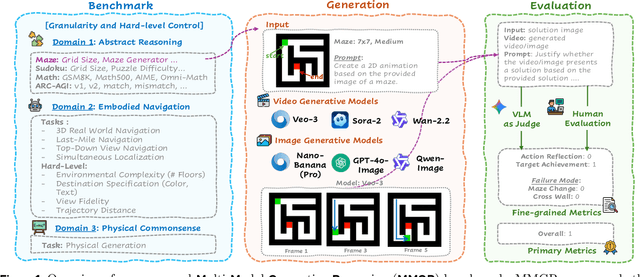
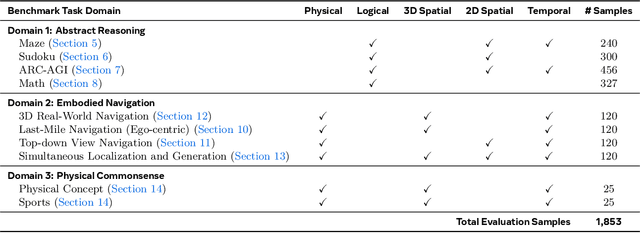
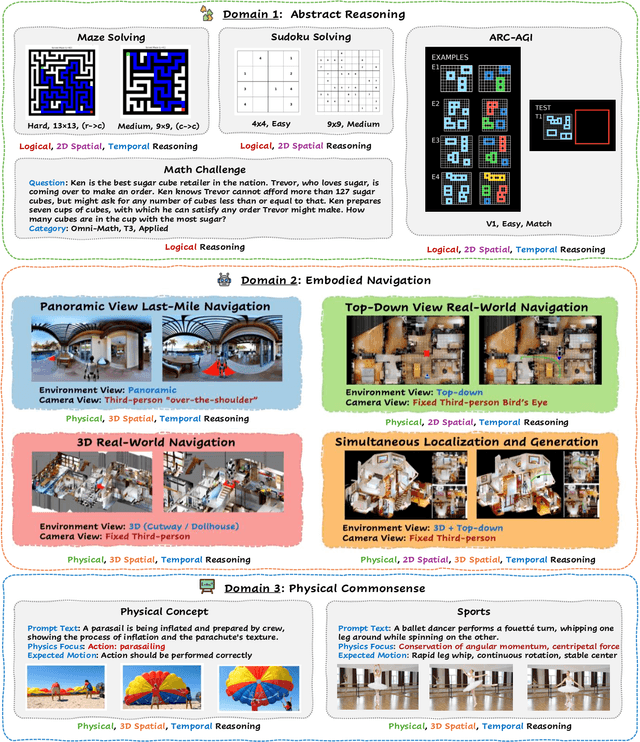
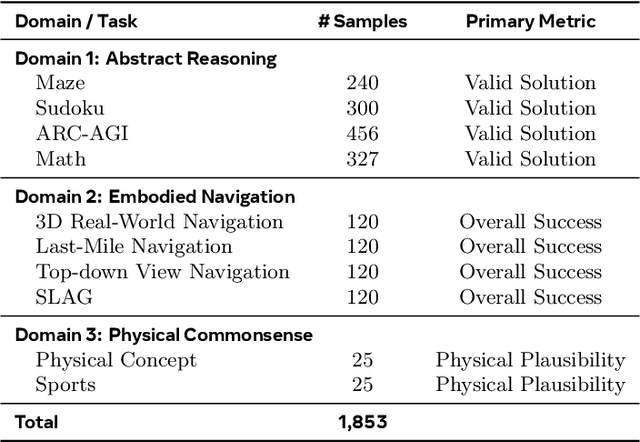
Video foundation models generate visually realistic and temporally coherent content, but their reliability as world simulators depends on whether they capture physical, logical, and spatial constraints. Existing metrics such as Frechet Video Distance (FVD) emphasize perceptual quality and overlook reasoning failures, including violations of causality, physics, and global consistency. We introduce MMGR (Multi-Modal Generative Reasoning Evaluation and Benchmark), a principled evaluation framework based on five reasoning abilities: Physical, Logical, 3D Spatial, 2D Spatial, and Temporal. MMGR evaluates generative reasoning across three domains: Abstract Reasoning (ARC-AGI, Sudoku), Embodied Navigation (real-world 3D navigation and localization), and Physical Commonsense (sports and compositional interactions). MMGR applies fine-grained metrics that require holistic correctness across both video and image generation. We benchmark leading video models (Veo-3, Sora-2, Wan-2.2) and image models (Nano-banana, Nano-banana Pro, GPT-4o-image, Qwen-image), revealing strong performance gaps across domains. Models show moderate success on Physical Commonsense tasks but perform poorly on Abstract Reasoning (below 10 percent accuracy on ARC-AGI) and struggle with long-horizon spatial planning in embodied settings. Our analysis highlights key limitations in current models, including overreliance on perceptual data, weak global state consistency, and objectives that reward visual plausibility over causal correctness. MMGR offers a unified diagnostic benchmark and a path toward reasoning-aware generative world models.
SwiReasoning: Switch-Thinking in Latent and Explicit for Pareto-Superior Reasoning LLMs
Oct 06, 2025Recent work shows that, beyond discrete reasoning through explicit chain-of-thought steps, which are limited by the boundaries of natural languages, large language models (LLMs) can also reason continuously in latent space, allowing richer information per step and thereby improving token efficiency. Despite this promise, latent reasoning still faces two challenges, especially in training-free settings: 1) purely latent reasoning broadens the search distribution by maintaining multiple implicit paths, which diffuses probability mass, introduces noise, and impedes convergence to a single high-confidence solution, thereby hurting accuracy; and 2) overthinking persists even without explicit text, wasting tokens and degrading efficiency. To address these issues, we introduce SwiReasoning, a training-free framework for LLM reasoning which features two key innovations: 1) SwiReasoning dynamically switches between explicit and latent reasoning, guided by block-wise confidence estimated from entropy trends in next-token distributions, to balance exploration and exploitation and promote timely convergence. 2) By limiting the maximum number of thinking-block switches, SwiReasoning curbs overthinking and improves token efficiency across varying problem difficulties. On widely used mathematics and STEM benchmarks, SwiReasoning consistently improves average accuracy by 1.5%-2.8% across reasoning LLMs of different model families and scales. Furthermore, under constrained budgets, SwiReasoning improves average token efficiency by 56%-79%, with larger gains as budgets tighten.
Scaling Up Audio-Synchronized Visual Animation: An Efficient Training Paradigm
Aug 05, 2025Recent advances in audio-synchronized visual animation enable control of video content using audios from specific classes. However, existing methods rely heavily on expensive manual curation of high-quality, class-specific training videos, posing challenges to scaling up to diverse audio-video classes in the open world. In this work, we propose an efficient two-stage training paradigm to scale up audio-synchronized visual animation using abundant but noisy videos. In stage one, we automatically curate large-scale videos for pretraining, allowing the model to learn diverse but imperfect audio-video alignments. In stage two, we finetune the model on manually curated high-quality examples, but only at a small scale, significantly reducing the required human effort. We further enhance synchronization by allowing each frame to access rich audio context via multi-feature conditioning and window attention. To efficiently train the model, we leverage pretrained text-to-video generator and audio encoders, introducing only 1.9\% additional trainable parameters to learn audio-conditioning capability without compromising the generator's prior knowledge. For evaluation, we introduce AVSync48, a benchmark with videos from 48 classes, which is 3$\times$ more diverse than previous benchmarks. Extensive experiments show that our method significantly reduces reliance on manual curation by over 10$\times$, while generalizing to many open classes.
R-KV: Redundancy-aware KV Cache Compression for Training-Free Reasoning Models Acceleration
May 30, 2025Reasoning models have demonstrated impressive performance in self-reflection and chain-of-thought reasoning. However, they often produce excessively long outputs, leading to prohibitively large key-value (KV) caches during inference. While chain-of-thought inference significantly improves performance on complex reasoning tasks, it can also lead to reasoning failures when deployed with existing KV cache compression approaches. To address this, we propose Redundancy-aware KV Cache Compression for Reasoning models (R-KV), a novel method specifically targeting redundant tokens in reasoning models. Our method preserves nearly 100% of the full KV cache performance using only 10% of the KV cache, substantially outperforming existing KV cache baselines, which reach only 60% of the performance. Remarkably, R-KV even achieves 105% of full KV cache performance with 16% of the KV cache. This KV-cache reduction also leads to a 90% memory saving and a 6.6X throughput over standard chain-of-thought reasoning inference. Experimental results show that R-KV consistently outperforms existing KV cache compression baselines across two mathematical reasoning datasets.
VisualToolAgent (VisTA): A Reinforcement Learning Framework for Visual Tool Selection
May 26, 2025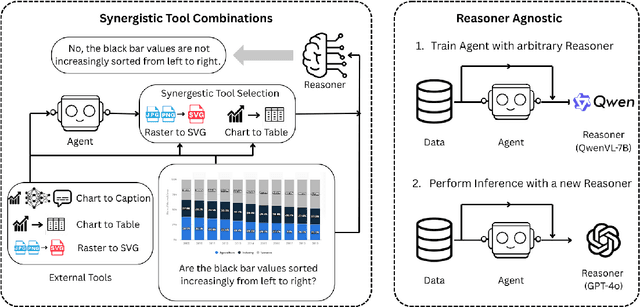
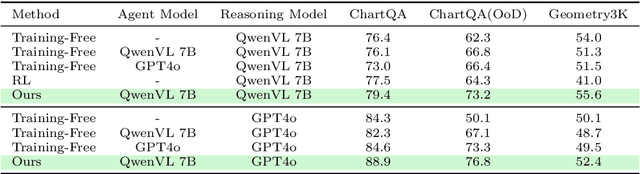
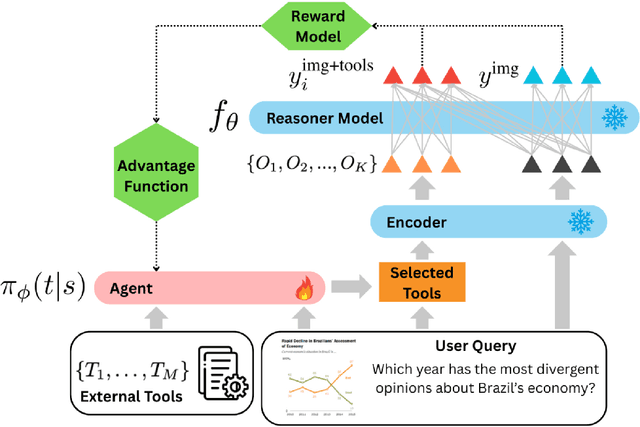
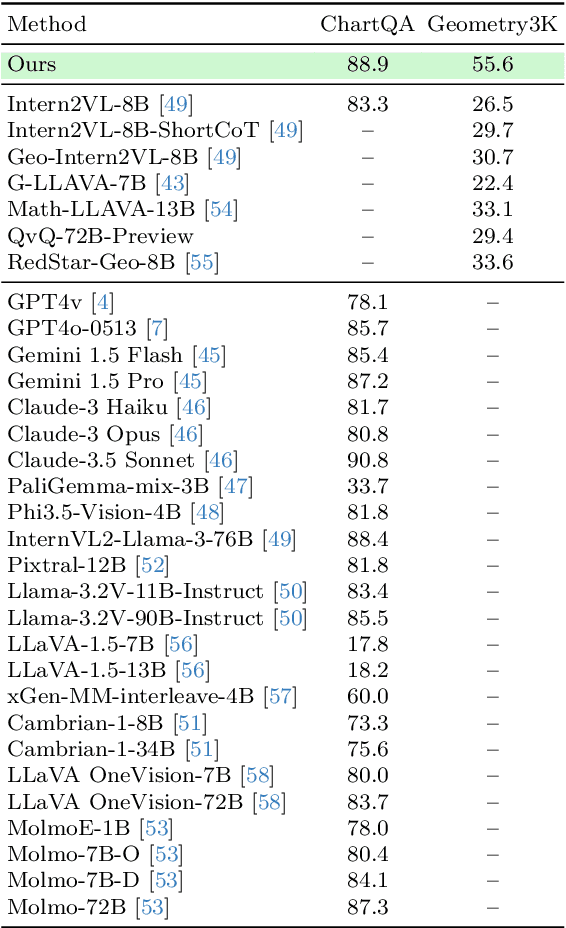
We introduce VisTA, a new reinforcement learning framework that empowers visual agents to dynamically explore, select, and combine tools from a diverse library based on empirical performance. Existing methods for tool-augmented reasoning either rely on training-free prompting or large-scale fine-tuning; both lack active tool exploration and typically assume limited tool diversity, and fine-tuning methods additionally demand extensive human supervision. In contrast, VisTA leverages end-to-end reinforcement learning to iteratively refine sophisticated, query-specific tool selection strategies, using task outcomes as feedback signals. Through Group Relative Policy Optimization (GRPO), our framework enables an agent to autonomously discover effective tool-selection pathways without requiring explicit reasoning supervision. Experiments on the ChartQA, Geometry3K, and BlindTest benchmarks demonstrate that VisTA achieves substantial performance gains over training-free baselines, especially on out-of-distribution examples. These results highlight VisTA's ability to enhance generalization, adaptively utilize diverse tools, and pave the way for flexible, experience-driven visual reasoning systems.
HeadInfer: Memory-Efficient LLM Inference by Head-wise Offloading
Feb 18, 2025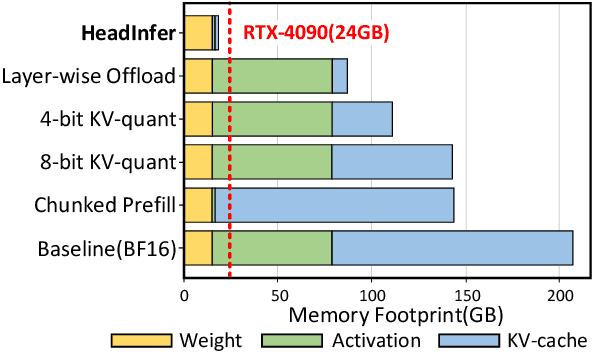
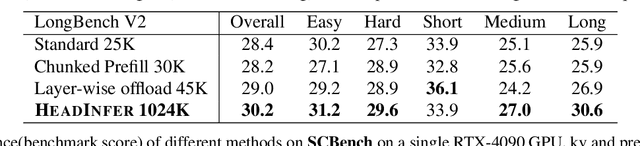
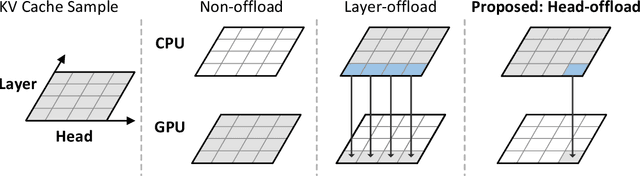

Transformer-based large language models (LLMs) demonstrate impressive performance in long context generation. Extending the context length has disproportionately shifted the memory footprint of LLMs during inference to the key-value cache (KV cache). In this paper, we propose HEADINFER, which offloads the KV cache to CPU RAM while avoiding the need to fully store the KV cache for any transformer layer on the GPU. HEADINFER employs a fine-grained, head-wise offloading strategy, maintaining only selective attention heads KV cache on the GPU while computing attention output dynamically. Through roofline analysis, we demonstrate that HEADINFER maintains computational efficiency while significantly reducing memory footprint. We evaluate HEADINFER on the Llama-3-8B model with a 1-million-token sequence, reducing the GPU memory footprint of the KV cache from 128 GB to 1 GB and the total GPU memory usage from 207 GB to 17 GB, achieving a 92% reduction compared to BF16 baseline inference. Notably, HEADINFER enables 4-million-token inference with an 8B model on a single consumer GPU with 24GB memory (e.g., NVIDIA RTX 4090) without approximation methods.
Next Token Prediction Towards Multimodal Intelligence: A Comprehensive Survey
Dec 30, 2024


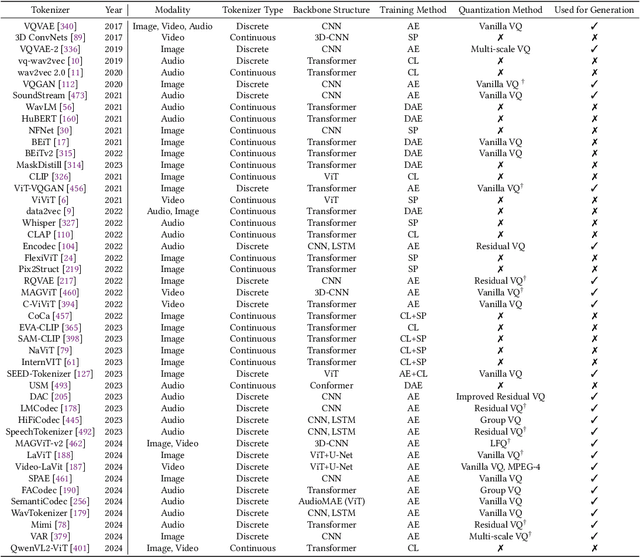
Building on the foundations of language modeling in natural language processing, Next Token Prediction (NTP) has evolved into a versatile training objective for machine learning tasks across various modalities, achieving considerable success. As Large Language Models (LLMs) have advanced to unify understanding and generation tasks within the textual modality, recent research has shown that tasks from different modalities can also be effectively encapsulated within the NTP framework, transforming the multimodal information into tokens and predict the next one given the context. This survey introduces a comprehensive taxonomy that unifies both understanding and generation within multimodal learning through the lens of NTP. The proposed taxonomy covers five key aspects: Multimodal tokenization, MMNTP model architectures, unified task representation, datasets \& evaluation, and open challenges. This new taxonomy aims to aid researchers in their exploration of multimodal intelligence. An associated GitHub repository collecting the latest papers and repos is available at https://github.com/LMM101/Awesome-Multimodal-Next-Token-Prediction